
Today, anyone who understands or studies English knows the English alphabet has twenty-six letters. Emphasis on the word today since English has lost and gained several letters over the centuries. Many of these losses and gains help us explain why we pronounce the same letter combinations differently. For example, th in this doesn’t sound the same as the th in thing.
This post covers just five letters we lost—Æ, Œ, Ð, Þ, and Ƿ. Letters like Ŋ, ſ, Ᵹ, and many others that have also slipped away will be left for another day. I chose today’s five because two (Æ and Œ) are still sometimes used, and the other three are just interesting for varying reasons. As usual, a few references are available at the end for further reading.
Æ, æ (Ash) and Œ, œ (Ethel)
May as well start with the ligature in the post title, æ, which is called ash, also spelled as æsc (Algeo 2010, 40; Smith 2009, 40). The name comes from the runic alphabet, but the ligature itself is an Anglo-Saxon adaptation from the Latin digraph ae. The ash ligature would have sounded a little like the a in cat (Algeo 40), but more like being between the modern a and e. While æ has mostly been pushed to the wayside in Modern English in favor of e, it does sometimes appear. Other than the rarely used æther in the post title, other words include archæology, encyclopædia, and anæmia. Surely, you have heard of Encyclopædia Britannica.
Œ is another Anglo-Saxon adaptation formed from a digraph, this time from the Latin oe. It is called ethel. Phonetically, œ sounded like an o-umlaut (ö). I went over the umlaut in previous articles on adding diacritics and English plurals. In British English, the ligature sometimes appears in words like amœba and similar loanwords (Algeo 39–40), but is often replaced with e. In American English, œ is generally replaced with e but not always.
Þ, þ (Thorn) and Ð, ð (Eth)
Þ, þ (thorn) and Ð, ð (eth or edh) have a linkage with each other. Thorn was pronounced as the th in thing and three ([θ], a voiceless dental fricative). Eth was pronounced as the th in that and the ([ð], a voiced dental fricative). However, the two pronunciations were often used interchangeably with both letters (Algeo 41; Crystal 2019, 16). Thorn was sometimes used as shorthand for the word that, but never eth. Eth was adopted from the Roman alphabet with a modification by putting a line through the d (Algeo 41; Roberts 2016, 8; Smith 40). Thorn was a runic symbol by the same name (Crystal 9); the shape of it changed over time. An evolutionary representation is illustrated below, from left to right.
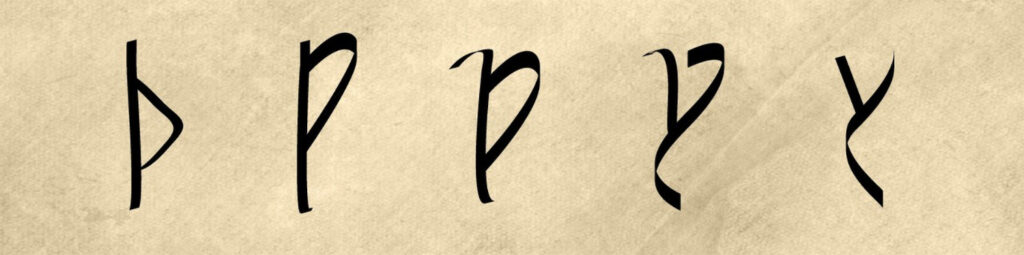
The most important thing to note is that the last symbol in the above progression looks like the letter y. However, despite appearances, it retained the [θ] and [ð] pronunciations. In the early days of printing, fonts generally came from the continent, and thorn wasn’t usually included, so y was used as the replacement. To distinguish thorn from y, printers would type the words the and thee as follows (Algeo 142).
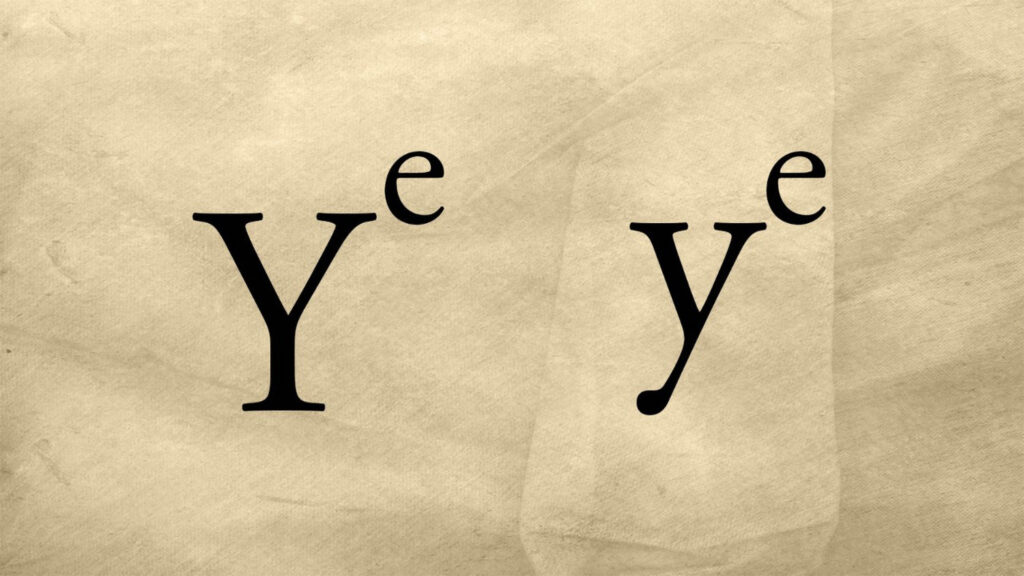
This convention eventually turned into a simple ye. So, ye in a sign like “Ye Olde Pub” in typical tourist hotspots should be pronounced as the ([ði] or [ðə]).
Because thorn and eth were sometimes used interchangeably, after the Norman invasion of 1066, Norman scribes introduced the th digraph to represent thorn and eth (Algeo 41). And this is why one spelling, th, covers two different sounds in English today.
Ƿ, ƿ (Wynn)
Ƿ, ƿ (wynn or wyn) is a bit of a fun one because it leads us to understand why we call w “double u.” Before getting into that, phonetically wynn sounds like [w]. Like thorn, it also came from the runic alphabet but with a comparatively simpler progression from ᚹ to ƿ. One of the big problems was the shape of the letter. It looks like p, and that led to the downfall of wynn. Scribes started using two us or two vs as representative forms for wynn, indicating that it should sound like [w] (Roberts 8). It is important to note that the u and v forms were pretty much used indiscriminately (Algeo 142).
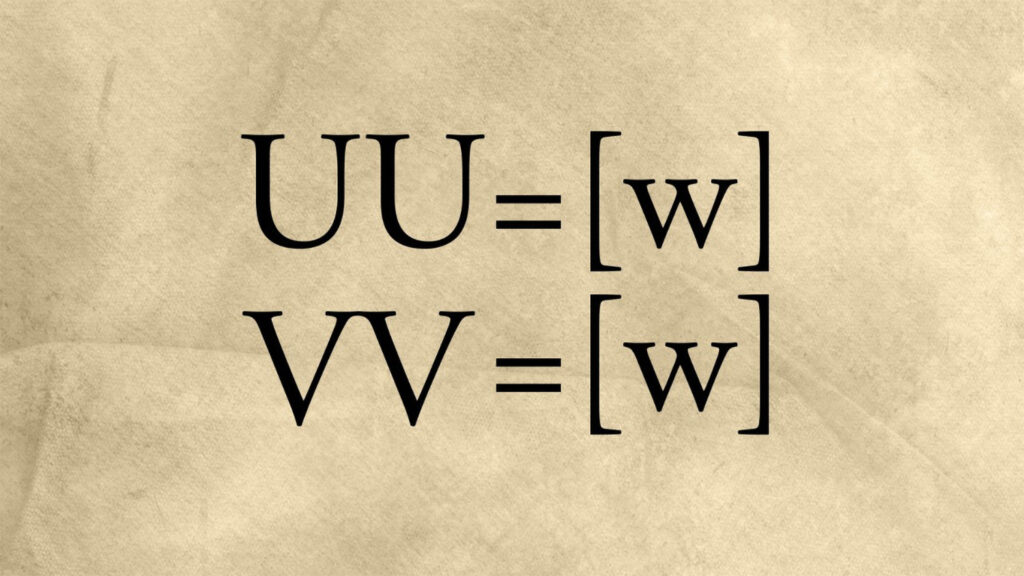
The two us became the standard, and this is why we call w “double u,” even if the physical shape of the letter more often closely resembles “double v.”
Conclusion
As mentioned, several letters have come and gone in English over a very long period. Given today’s shorthand way of writing in texts, I wonder what letters may be added and removed in the future. Maybe we will take on a new form of hieroglyphics by adding emojis into the alphabet over time. I hope not, but anything is possible. 😉 ㅋㅋㅋ. Take care.
References
Algeo, John. 2010. The Origins and Development of the English Language. 6th ed. Boston: Wadsworth.
Crystal, David. 2019. The Cambridge Encyclopedia of the English Language. 3rd ed. Cambridge: Cambridge University Press.
Roberts, Jane. 2016. Guide to Scripts Used in English Writings Up to 1500. Liverpool: Liverpool University Press.
Smith, Jeremy. 2009. Old English: A Linguistic Introduction. Cambridge: Cambridge University Press.